For more complex and knowledge-intensive tasks, it’s possible to build a language model-based system that accesses external knowledge sources to complete tasks. This enables more factual consistency, improves reliability of the generated responses, and helps to mitigate the problem of “hallucination”.
RAG combines an information retrieval component with a text generator model. RAG can be fine-tuned and it’s internal knowledge can be modified in an efficient manner and without needing retraining of the entire model.
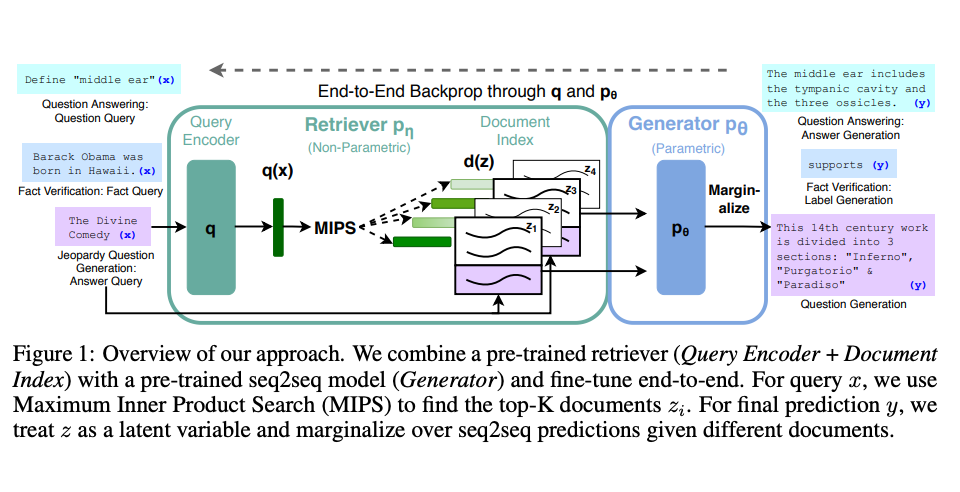
RAG takes an input and retrieves a set of relevant/supporting documents given a source (e.g., Wikipedia). The documents are concatenated as context with the original input prompt and fed to the text generator which produces the final output. This makes RAG adaptive for situations where facts could evolve over time. This is very useful as LLMs’s parametric knowledge is static. RAG allows language models to bypass retraining, enabling access to the latest information for generating reliable outputs via retrieval-based generation.
A pre-trained seq2seq model is used as the parametric memory and a dense vector index of Wikipedia is used as non-parametric memory (accessed using a neural pre-trained retriever). Below is a overview of how the approach works:
This shows the potential of RAG as a viable option for enhancing outputs of language models in knowledge-intensive tasks.
More recently, these retriever-based approaches have become more popular and are combined with popular LLMs like ChatGPT to improve capabilities and factual consistency.